 Maryland Injury Law Center


Foot injuries are uniquely difficult personal injury cases. One-fourth of the bones in your body are in your feet, and many of those bones are small and tightly packed together. A fracture can disrupt the joints, ligaments, tendons, nerves, and weight-bearing mechanics around it. There are simply too many things that can go wrong.
The settlement value of a foot injury depends heavily on whether the victim can return to walking, standing, running, and working without significant pain or restriction. A fracture that heals in eight weeks is one type of case. A Lisfranc injury, crushed heel, open fracture, or failed surgical repair that permanently changes the victim’s gait is an entirely different claim.
Our lawyers at Miller & Zois have handled scores of foot fracture claims arising from car accidents, truck crashes, pedestrian collisions, construction accidents, and dangerous property conditions. Call us at 800-553-8082 or contact us online for a free case review.
Substantively updated: July 31, 2026
Legal review: Ronald V. Miller Jr.
What Is the Average Settlement Value of a Foot Injury Claim?
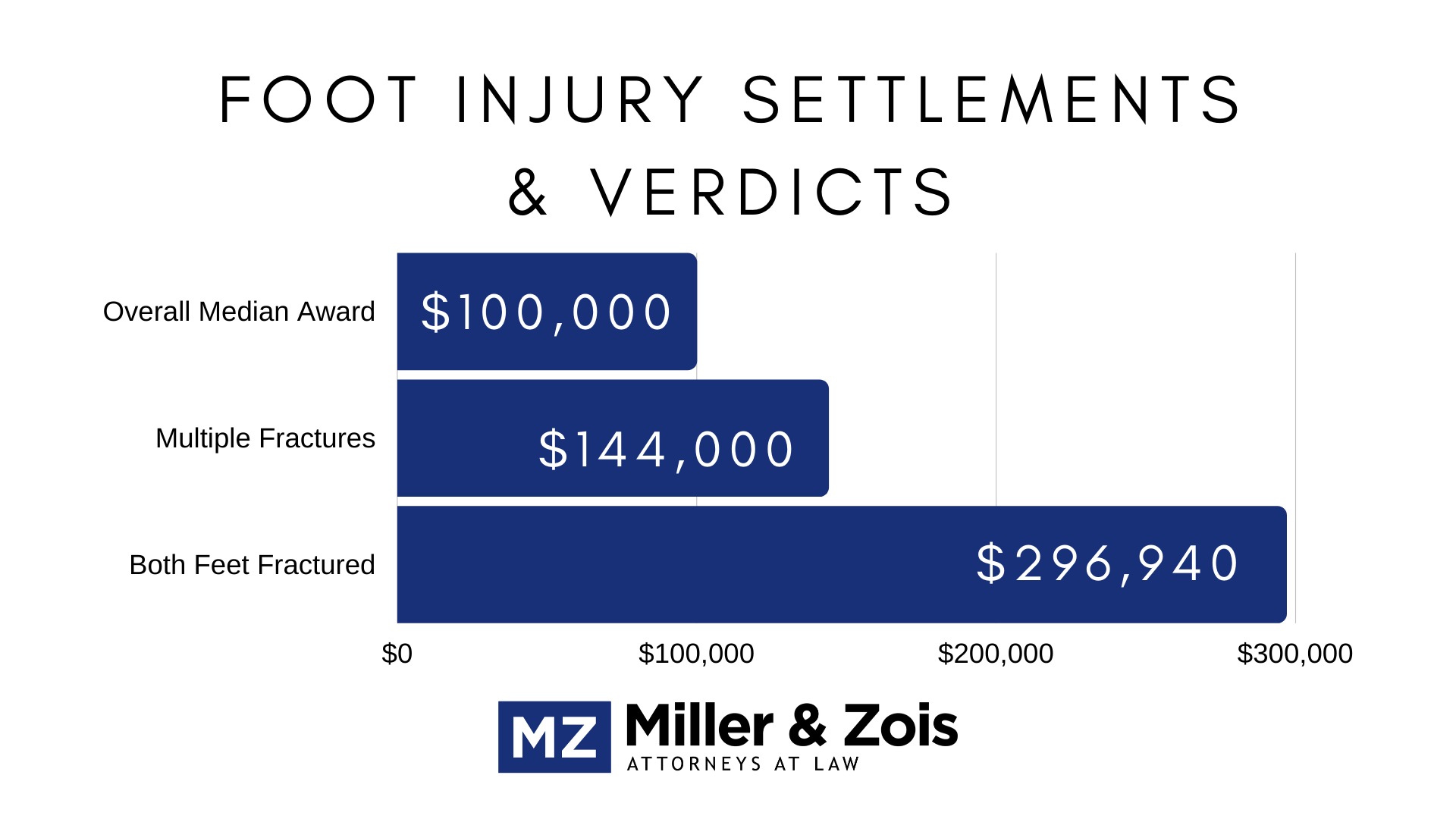
Historical Jury Verdict Research data places the overall median jury award for foot injuries at approximately $100,000. Multiple fractures to one foot increase the reported median to $144,000. When both feet are fractured, the reported median rises to $296,940.
These figures describe jury verdicts from the study rather than a complete database of settlements. They also combine injuries of different severity, jurisdictions, liability facts, and insurance limits. The median still provides a useful point of reference because half of the verdicts were above the figure and half were below it.
The same Jury Verdict Research material found that 39% of foot injury cases that reached a verdict arose from motor vehicle collisions. Another 11% involved motorcycle accidents. That second figure is remarkable. Motorcycles account for a much smaller share of total roadway travel, but riders have little protection when a car, truck, or pavement crushes or twists a foot.
Bilateral fractures tend to arise from violent impacts. If both feet are broken, the collision is usually severe enough to generate significant force throughout the body. The victim may also be unable to bear weight on either side, creating a much harder recovery and a greater need for assistance.
What Drives the Settlement Value of a Foot Injury?
The number of fractures is only one part of the valuation. Our lawyers start with what the victim could do before the accident, what the medical evidence shows, and what the injury prevents the victim from doing now.
Permanent Walking and Standing Restrictions
The most important value driver is whether the victim has permanent restrictions on high-demand activities such as walking, running, climbing, or standing for long periods. If the limitations are permanent, settlement value usually rises dramatically.
This is especially important for construction workers, nurses, warehouse employees, mechanics, police officers, restaurant workers, delivery drivers, and anyone else who spends most of the workday on their feet. A person may return to some form of employment and still have a substantial lost-earning-capacity claim if the injury ends a physically demanding career.
Post-Traumatic Arthritis
Joint damage can lead to arthritis years after the fracture has healed. This commonly becomes a concern after injuries involving the ankle joint, subtalar joint, midfoot, talus, calcaneus, or Lisfranc complex.
Arthritis may cause stiffness, swelling, reduced range of motion, and pain during weight-bearing activity. A future fusion or joint reconstruction recommendation can add substantial value, particularly when the treating surgeon explains why the procedure is likely to become necessary.
Changes in Gait
A permanent limp can create problems beyond the injured foot. An altered gait may place additional stress on the ankle, knee, hip, and lower back. Jurors can also see a limp. Visible evidence of an injury often carries more force than a written description in a medical report.
Time Away From Work
Foot fractures frequently prevent weight-bearing for weeks or months. Victims may progress from a wheelchair to crutches, a walking boot, and eventually supportive shoes. A physically demanding job may remain impossible even after the doctor permits limited walking.
Lost wages, reduced overtime, missed promotions, retraining, and diminished earning capacity can become major components of the claim. Good employment records and a clear opinion from the treating doctor make these losses easier to prove.
Liability and Available Insurance
A severe injury does not erase a liability dispute. The settlement calculation still depends on whether the defendant caused the accident, whether the victim shares any fault, and whether enough insurance or other assets are available to pay the claim.
A $30,000 automobile policy may be exhausted quickly by surgery and hospitalization. Our lawyers investigate underinsured motorist coverage, commercial policies, employer responsibility, additional defendants, and other available sources of compensation.
Types of Traumatic Foot Fractures Our Lawyers See
Doctors classify fractures by their location, alignment, severity, and effect on surrounding tissue. The following descriptions are useful, although the actual value depends on how the particular injury heals.
- Stress fractures: small cracks caused by repetitive stress or overuse. We see them less often in personal injury car accident claims because acute trauma usually causes a different fracture pattern.
- Avulsion fractures: An avulsion occurs when a tendon or ligament pulls a small piece of bone away from its attachment point. The significance depends on the location, displacement, joint involvement, and resulting instability.
- Compression or crush fractures: These occur when substantial force crushes the bones of the foot. Recovery can be difficult because the injury may damage several bones, joints, nerves, blood vessels, and soft tissues simultaneously.
- Displaced fractures: The broken pieces have moved out of proper alignment. Treatment may require reduction, surgery, and internal fixation with plates, screws, pins, or wires.
- Nondisplaced fractures: The bone is broken but remains in acceptable alignment. Many heal with immobilization or a walking boot. Some still produce serious long-term consequences when the fracture extends into a joint or fails to heal properly.
- Open fractures: The broken bone communicates with a wound through the skin, increasing the risk of contamination, infection, scarring, and soft-tissue damage. High payouts on these cases are in no small part because the pictures are usually awful-looking.
- Closed fractures: The skin remains intact. A closed fracture can still require surgery and lead to permanent disability, particularly when it is displaced, comminuted, or extends into a weight-bearing joint.
Foot Injuries With Higher Settlement Potential
Calcaneus Fractures
The calcaneus is the heel bone. It absorbs tremendous force while standing and walking. A crushed or displaced calcaneus fracture can damage the subtalar joint and lead to chronic pain, loss of motion, arthritis, heel widening, difficulty fitting into shoes, and an inability to stand for long periods.
Many serious calcaneus fractures require open reduction and internal fixation. Some patients later need hardware removal or subtalar fusion. These cases can have substantial value when the victim has permanent restrictions or loses the ability to return to physical employment.
Lisfranc Injuries
A Lisfranc injury affects the joints and ligaments through the middle of the foot. These injuries can be missed during the initial emergency room visit, especially when early X-rays are taken without weight-bearing.
Delayed diagnosis can allow the midfoot to remain unstable. Even after surgery, the patient may develop arthritis, chronic swelling, loss of the foot’s normal arch, and pain with prolonged standing. Some patients eventually require fusion surgery.
Talus Fractures
The talus connects the foot and ankle and has a limited blood supply. A serious fracture can interrupt blood flow and cause avascular necrosis, in which part of the bone dies. Talus injuries may also cause ankle arthritis, stiffness, and permanent limitations in walking on uneven ground.
Multiple Metatarsal Fractures
One uncomplicated metatarsal fracture may heal with a boot and restricted activity. Several displaced metatarsal fractures can destabilize the forefoot, require fixation, and permanently affect balance and push-off strength.
Crush Injuries and Compartment Syndrome
A crushed foot can swell so severely that pressure builds inside closed muscle compartments and threatens nerves, blood vessels, and tissue. Emergency fasciotomy may be necessary to release that pressure. These cases can involve extensive scarring, nerve damage, repeated surgery, infection, and permanent work restrictions.
Foot Fracture Surgery and Future Medical Care
Open Reduction and Internal Fixation
An open reduction and internal fixation procedure, commonly called ORIF, allows the surgeon to expose the fracture, restore alignment, and stabilize the bones with plates, screws, pins, or other hardware. The goal is to maintain proper alignment while the fracture heals.
Surgery generally increases the value of a foot injury claim because it reflects the seriousness of the fracture, adds medical expenses, lengthens recovery, and creates additional pain and scarring. The eventual result remains critical. A successful repair followed by a full recovery has a different value from a repair followed by arthritis, hardware pain, nonunion, infection, or permanent restrictions.
Fusion Surgery
A fusion permanently joins damaged bones so that the painful joint no longer moves. Fusion may reduce pain, but the loss of motion can affect gait and place additional stress on surrounding joints. A future fusion recommendation can be a major part of a settlement demand.
Hardware Removal
Plates and screws can become painful or prominent under the relatively thin tissue around the foot. Some patients require a second operation after the fracture heals. The need for another procedure adds expense, recovery time, and risk.
Circular Fixation
In selected complex foot and ankle fractures, surgeons may use circular external fixation instead of, or in addition to, internal plates and screws. The frame stabilizes the injured area with pins or wires placed outside the body. Foot and ankle surgeons have continued to study this technique for difficult fracture patterns and for patients with serious soft-tissue concerns.
Foot Injury Settlements and Verdicts
The examples below show the wide range of possible outcomes. They should not be averaged. Several plaintiffs suffered injuries beyond the foot, and those additional injuries contributed to the result. We identify those cases so readers can see the difference between a foot-dominant claim and a broader polytrauma case.
2026, Florida: $6.4 Million Foot Infection and Amputation Verdict
A Charlotte County jury awarded $6.4 million to a man who lost his lower leg after seeking podiatric treatment for a chronic foot wound and possible bone infection. The lawsuit alleged that two podiatrists failed to recognize and adequately treat a worsening infection that included MRSA. The infection progressed, and the patient ultimately required a below-knee amputation. The jury assigned 100% of the fault to the defendants.
The award included $82,006.01 for past medical expenses, $345,000 for future medical care, $3.5 million for past pain and suffering, and $2.5 million for future pain and suffering. This was a medical malpractice case involving an amputation, so it offers little guidance for an ordinary foot fracture claim. It does show the extraordinary value juries may place on the permanent loss of mobility and independence caused by a catastrophic foot condition. The verdict remains subject to post-trial motions and appellate review.
2025, New Jersey: $50,000 Pedestrian Settlement
A 14-year-old boy was crossing an intersection in a marked crosswalk when a driver made a right turn on red and struck him. He suffered significant injuries to his foot and ankle. The claim reportedly settled for $50,000.
2024, Washington: $75,000 Retail Store Settlement
A customer was struck by a large wheeled stocking cart pushed by a store employee. She suffered trauma to her left foot and ankle, along with lacerations and headaches. The case settled for $75,000.
2020, Washington: $5,000 Foot and Achilles Award
A 40-year-old Boeing mechanic was riding in a vehicle involved in a collision. He alleged continuing pain, swelling, and tenderness around his right foot, ankle, and Achilles tendon. He reported difficulty walking long distances, standing for more than 5 minutes, and wearing high-heeled shoes or boots. The award was $5,000, showing the risk of a low result when the jury disputes causation, treatment, or the claimed severity of an injury.
2019, California: $1,207,500 Worksite Settlement
A 49-year-old foreman was struck by a backing asphalt transfer vehicle. He suffered fractures involving his foot, ankle, tibia, and fibula. Treatment included open reduction and internal fixation, a fasciotomy of the foot and leg, a short-leg splint, and later ankle arthroscopy. His doctors anticipated future fusion surgery.
The plaintiff alleged that the driver failed to watch for workers and that the backup alarm did not sound because the vehicle was moving in neutral. The driver disputed that account. The case settled for $1,207,500. Although several lower-leg injuries contributed to the value, the foot damage, fasciotomy, repeated procedures, and expected fusion were major features.
2018, New York: $85 Million Pedestrian Verdict
A double-decker sightseeing bus struck and dragged a former New York Times columnist in a Manhattan crosswalk. The collision transected the femoral artery in his leg. Surgeons repaired the artery but could not repair the femoral vein. He was left with permanent nerve damage, a foot drop, and loss of motor function in the leg. He spent 78 days in the hospital and underwent eleven operations.
The jury awarded $85 million. This verdict reflects catastrophic vascular and nerve trauma. The foot drop and lifelong need for a brace followed from the leg injury rather than a broken bone in the foot. This case should not be used as a benchmark for an ordinary foot injury claim. Verdicts at this level almost always involve serious injuries beyond the foot.
2018, Washington: $2,356,669 Verdict for Married Couple
A cement truck struck a married couple’s vehicle. The husband suffered fractures to his fingers and ribs, along with knee, hip, facial, and neck injuries. The wife suffered injuries to her right foot, including a fractured third toe, turf toe, and bruising across the top of the foot. She also sustained a seat-belt injury that caused a groin hernia.
The combined verdict was $2,356,669. The husband received $1.7 million in noneconomic damages and $99,305 in economic damages. The wife received $465,000 in noneconomic damages and $92,364 in economic damages. Because the verdict compensated two people for numerous injuries, it provides limited guidance on the value of the wife’s foot injury standing alone.
Evidence That Strengthens a Foot Injury Claim
A good foot injury case follows the medical record from the emergency room through the patient’s final restrictions. Useful evidence includes:
- Initial X-rays, CT scans, and MRI studies
- Operative reports and hardware records
- Postoperative imaging showing alignment and healing
- Photographs of open wounds, swelling, scarring, casts, and external fixation
- Physical therapy and gait evaluations
- Records documenting infection, nonunion, arthritis, or nerve injury
- Written work restrictions
- Wage and overtime records
- Testimony from family members and coworkers
- Future surgery and medical-cost estimates
One thing I strongly suggest in foot injury cases is finding an experienced doctor who specializes in foot and ankle injuries. Baltimore is uniquely blessed with world-renowned foot surgeons. If you have an orthopedic problem with your foot, take advantage of that abundance of riches and find someone well-qualified to chart the best path to recovery.